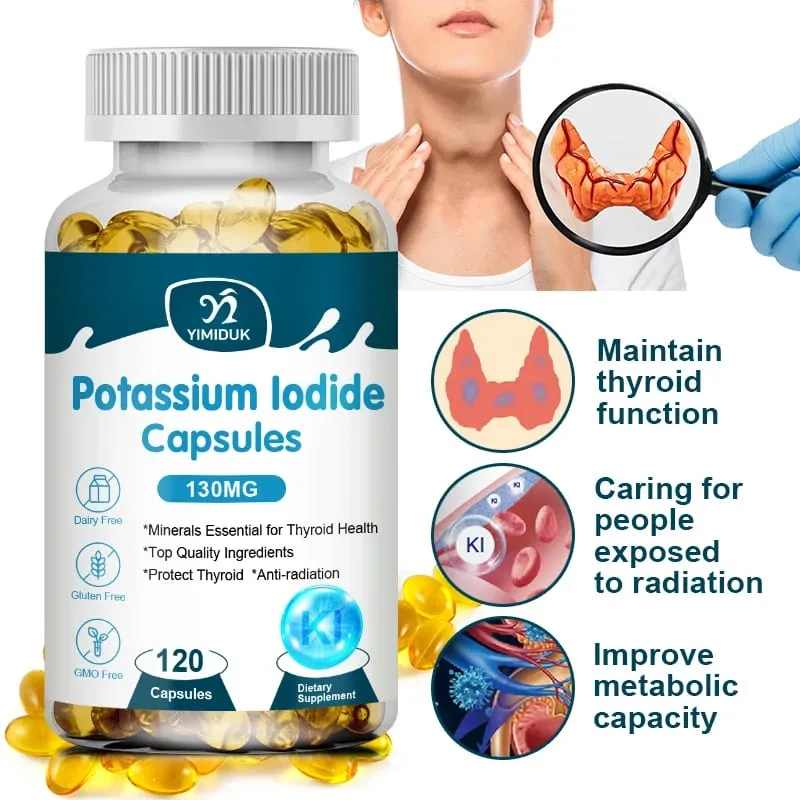
We started carrying potassium iodide capsules a few years back, mostly because customers kept asking for them and we got tired of saying no. At the time I figured it would be a niche thing — a few people prepping for emergencies, maybe some folks with iodine questions from their doctor. Turns out it's a steady seller, and the questions I get about it are some of the most thoughtful ones I answer all week. So here's the honest rundown on the bottle sitting on our shelf, SKU P3256805883264582, potassium iodide at 130 mcg per day.
Let's talk about what's actually in the bottle first, because this is one of those products where the manufacturing matters more than people realize. Each capsule is pharmaceutical-grade potassium iodide — that's the stable form of iodine, not the radioactive stuff you hear about on the news, which is exactly the point of taking it. The capsules themselves are gelatin-based with the KI powder inside, and the formula is deliberately simple: no fillers that don't need to be there, no proprietary blends hiding dosages, no mystery herbs. It's made in the USA, and the supplier backs it with published research rather than marketing fluff. When I opened my first bottle to check the seal and shake a few out, the capsules were uniform, no dust, no cracked shells. That sounds like a low bar, but you'd be surprised how many budget supplements fail it.
Specifications, since I know some of you want the numbers. Each capsule delivers 130 micrograms of potassium iodide, which is the daily amount — so it's one capsule a day, not three or four. You can get it in a single bottle or a three-bottle bundle, and honestly the bundle is what most repeat customers go with once they know it works for them. There are no color options here, because it's a supplement and not a piece of furniture, but the bottles are amber-tinted with a child-resistant cap and a foil induction seal under the lid. The three-bottle option isn't fancy packaging — it's just three of the same bottle, which keeps the cost down. At $23.10 for the single, it works out to under a dollar a day, and the bundle brings that down further.
So what do people actually do with this? Three scenarios come up again and again at our counter. First, thyroid support — if your doctor has flagged low iodine or you're dealing with sluggish thyroid function, this is a straightforward way to cover the gap without guessing at seaweed snacks. Second, and this is the big one, emergency preparedness. Families in areas near nuclear plants or just cautious households keep a bottle in the go-bag, because in a radiation event, stable iodine saturates the thyroid so it doesn't absorb radioactive iodine. Third, general metabolism and energy — iodine is a building block for thyroid hormones, and if you're deficient, your metabolism drags. I've had customers tell me their afternoon crashes got less brutal after a couple months, though I always tell them that's anecdotal and not a guarantee.
How to use it is dead simple, which I appreciate. One capsule daily with food, swallowed with water, unless your physician says otherwise. Don't double up thinking more is better — iodine has a ceiling, and exceeding it can cause problems instead of solving them. For storage, keep the bottle in a cool, dry place, away from the bathroom shelf because steam is the enemy of capsules. The seal keeps it fresh for the full expiration date, which is printed on the bottom, and there's no refrigeration needed. If you're taking thyroid medication, pregnant, or nursing, talk to your doctor before starting — that's not legal boilerplate, I mean it.
Pros: the dosage is precise and honest, the ingredient list is clean, it's made domestically, and one capsule a day is easy to remember. It plays well with a multivitamin as long as you check total iodine intake. Cons, and I'll be straight with you: the bottle is plain, there's no fancy dropper or gummy version for people who hate swallowing pills, and at 130 mcg it's not a mega-dose — if your doctor wants you on a higher therapeutic amount, this alone won't get you there. Also, and this is the one that bites people, it's not a radiation antidote you take casually. It's for a real exposure event, on public health instructions, not a daily "just in case" for the end of the world. I've had to talk a few customers out of that mindset, and I'll do it again if I have to.
From a formulation standpoint, the design here is smart in a boring way, which is the best kind. Potassium iodide is stable, cheap, and well-studied, so there's no reason to dress it up with chelated this or liposomal that. The 130 mcg dose matches the RDA for most adults, meaning it fills a deficiency without pushing you into excess — that balance is the whole trick, and plenty of supplements get it wrong by overloading. It suits people who've been told they need iodine, who want a no-nonsense daily capsule, or who are building a serious emergency kit and want one reputable piece of it. It doesn't suit anyone looking for a miracle energy pill or a substitute for actual medical care for a thyroid condition. Nothing on this shelf is that, and I'd rather you hear it from me now.