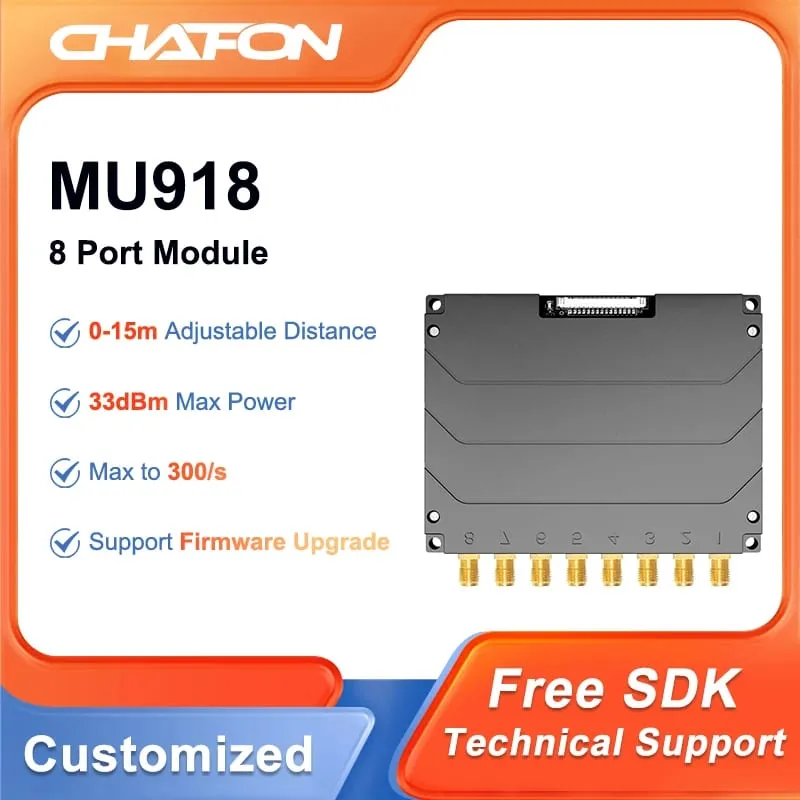
Let me start by getting one thing out of the way, because I know how this looks. Our store is called a toys and games shop, and I'm about to write about an industrial RFID reader. We stock a lot of odd things because our customers are tinkerers, hobbyist engineers, warehouse IT folks who buy on a company card, and people building weird projects in their garage. The MU918 landed in our catalog through a supplier we trust, and after playing with one on the bench for a couple of weeks, I get why warehouses keep buying it. SKU is P2251832517569316 if you want to jump straight to the listing.
First, the physical stuff, because a lot of cheap reader boards feel like they were assembled during a power outage. The MU918 is not that. It's a dense little module built around a metal-shielded RF section, and the PCB is thick with proper soldering throughout. The eight antenna connectors are surfaced-mounted SMA-style jacks, which is the right call — those take real torque without ripping pads off the board. The housing on the module itself is minimal, since this thing is meant to be embedded inside a cabinet or mounted on a panel rather than tossed on a desk, but the shielding cans over the RF stages are soldered down flat and secure. I dropped one from about a meter onto concrete while moving boxes. It still reads. That's my build quality test and it passed.
Now the specs, laid out plainly because you'll want to compare. The MU918, model CF918, runs 865–868MHz under EU standards or 902–928MHz for the US band. Protocol is ISO18000-6C, which is the standard EPC Gen2 stuff almost every UHF tag in circulation speaks. RF power goes up to 33dBm and it's adjustable, so you can turn it down when you're working in tight quarters. Inventory speed is rated at 300 tags per second, which in real terms means a full shelf gets counted in about a blink. Read distance is 0–15 meters depending on which antenna and tag you pair it with. Power supply is 3.6 to 5.5V. The interface is RS232 at TTL level, so if you're not comfortable with serial lines you'll want a converter or a controller board that already speaks that language. Antenna ports: eight of them. On sizes and colors — this isn't a fashion item. There are no color options and no size variants. It's one standard module measured in PCB dimensions, and you mount it where it fits. Dimensions are in the listing photos if you need to check clearance.
What do people actually do with it? Three patterns come up again and again. Warehouses with wide racking use all eight ports to cover eight directions from one reader, which saves buying eight separate readers and syncing them. That's the whole point of this model. Second scenario: an automated conveyor line where the module reads pallets rolling past two or three tunnels, all from a single unit tucked in a control cabinet. Third, and this is the fun one, people use it for race timing and event check-in — bibs with UHF tags, antennas at the finish line, and 300 reads per second means nobody gets missed in a crowd. Not the intended use, but it works, and I love that.
Using it is not plug-and-play, I won't pretend otherwise. You connect RS232 TTL lines to your host, power it from a regulated 5V supply, attach your antennas, and write or configure software that sends inventory commands and parses returns. Answer mode and real-time inventory mode are both supported, and which one you pick depends on whether you want the reader listening constantly or responding on demand. For maintenance, keep the ports dry and dust-free, use a bit of dielectric grease on outdoor antenna connections, and don't hot-plug antennas while the RF is running or you can stress the amplifier. Keep it away from your 5V rail's noisy neighbors too — clean power matters with a reader this sensitive.
Pros, honestly: eight ports from one unit is a genuinely rare feature at this price point of $162.26, it hits 33dBm with fine adjustment, it's fast, and the firmware handles standard Gen2 tags without drama. Cons, also honestly: it needs a host controller and software, so if you want an out-of-the-box scanner this is not it. The TTL serial interface is not USB, so add converter cost. There's no color or size choice, and no built-in display or buttons, because it's an OEM module, not a finished product. Finally, 15 meters is under ideal conditions — real racking, metal shelves, and liquids all cut that range down.
Why does this design work? Because UHF reading is a geometry problem more than a power problem. One strong reader switching between eight antennas beats eight weak readers tripping over each other's RF fields, and the multiplexed port architecture here does exactly that. The adjustable power and dual work modes let integrators tune coverage instead of brute-forcing it. It suits warehouse IT teams, systems integrators, automation builders, and serious makers building inventory or race-timing systems who can handle a serial interface. If you're dusty about UART and terminals, budget for help.